
Why do people enjoy pain?
Why do people enjoy pain?
BDSM, Endorphins, and the Brain: How Neuroscience Explains Pain, Pleasure, and Connection - For Beginners
At first glance, it seems counterintuitive: why would anyone enjoy pain? Our culture teaches us to avoid it, to see pain as a warning sign of damage. Yet within the world of BDSM, pain is reimagined and transformed into a source of pleasure, release, and connection. Far from being about suffering, consensual impact play offers intensity, ritual, and sensation that many describe as transcendent.
As an artisan flogger maker with a psychology and fine arts background, I’ve long been fascinated by the intersection of the mind, the body, and the tools we use to bridge them. Neuroscience gives us a window into why pain and pleasure so often walk hand in hand, and why BDSM can be so powerful.
Pain and Pleasure: The Brain’s Connection
The first key lies in the brain's structure itself. Pain and pleasure centres aren’t opposites; they’re neighbours. Neuroscientists have shown that both experiences activate overlapping neural pathways, particularly in regions linked to endorphin release, dopamine reward, and the body’s stress response system.
When the skin is struck with a flogger, cane, or hand, pain receptors send a signal to the brain. In an everyday context, say, stubbing your toe, the brain interprets this as a threat. But in a consensual BDSM scene, the framing is completely different: the pain is expected, desired, and controlled. Instead of triggering an alarm, the body responds by flooding the system with endorphins (natural painkillers) and dopamine (the reward chemical).
The result? This state is not unlike the “runner’s high” experienced by athletes. The body hums with adrenaline, the mind softens into altered awareness, and what would be “pain” outside of play becomes intensity, focus, and deep pleasure.
Consent, Control, and Context
One of the most important elements shaping this transformation is consent. Neuroscience has repeatedly shown that context changes perception. Pain received in a medical procedure, where we may feel powerless or fearful, is interpreted as distress. But pain received in a consensual BDSM scene with trust, boundaries, and safe words is interpreted as exciting, erotic, or even comforting.
This difference lies not in the sensation itself, but in how the brain frames it. Choice and safety rewire the emotional meaning of pain. This is why BDSM practitioners often describe their play not as harmful, but as deeply bonding. The submissive surrenders, knowing they are held in safety; the Dominant delivers sensation, knowing it is welcomed. Together, they co-create an altered state where pain serves connection.
The Psychology of Sensation Play
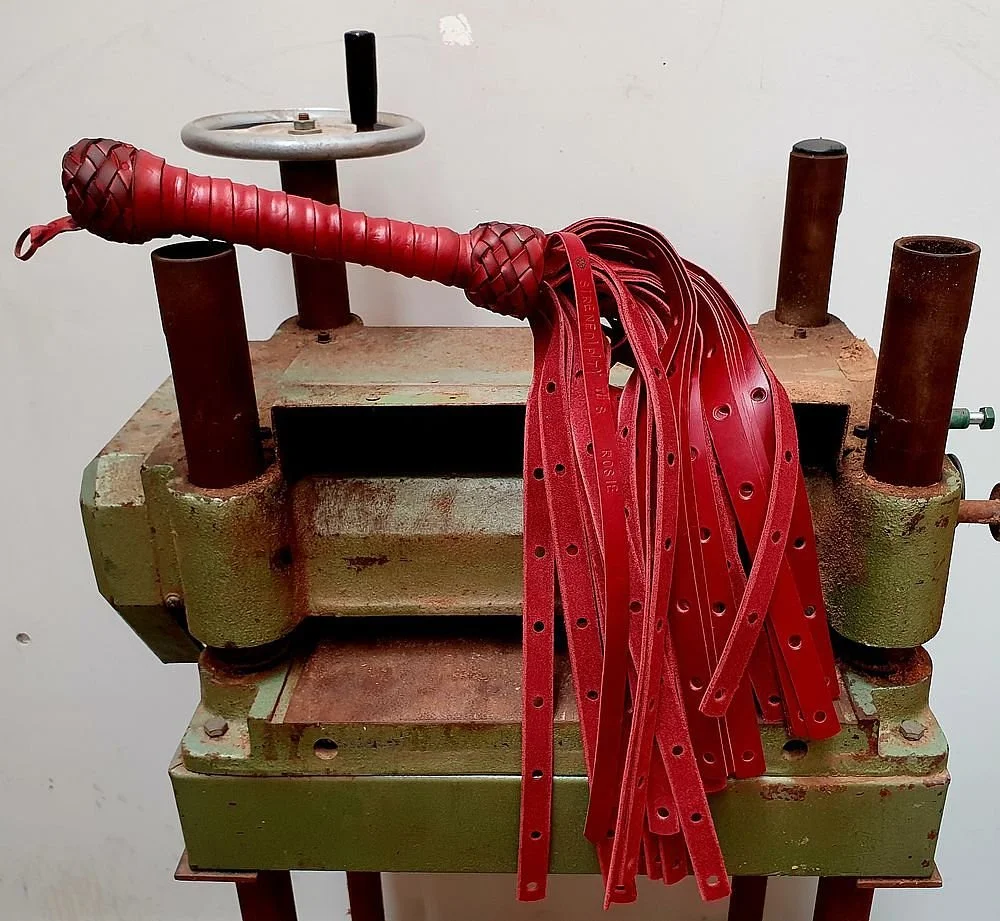
From a psychological perspective, pain in BDSM isn’t about injury. It’s about sensation, intensity, and ritual. Implements like floggers are valued not only for their aesthetic beauty, but for their ability to create a spectrum of sensations.
A heavy soft leather flogger delivers a deep, thudding impact that resonates through the body. A suede or heavier leather may offer a sharper sting. When applied in rhythm, these sensations can induce a meditative trance-like state known in the BDSM community as “subspace.”
This altered state has parallels in mindfulness practices and even religious ritual: focused attention, rhythmic repetition, surrender, and catharsis. For some, it is a form of stress release. For others, it is a pathway to intimacy and vulnerability.
The Role of Artistry
Because sensation is so central, the choice of implement matters. A flogger is not just a tool; it is an extension of intention. The weight, balance, texture, and design all shape the experience. This is why many turn to artisan floggers rather than mass-produced implements: the artistry ensures not only durability, but a sensitivity to how the body will feel each strike.
In my work, I approach flogger-making as both a craft and steeped in psychology. Using carefully selected premium Tuscan leather, Australian kangaroo hide, and exotic skins, I create implements designed for longevity and tactile richness. Each flogger is named, numbered, and infused with its own identity, a reminder that these are not disposable objects, but companions in sensation.
Why We Like Pain
So, why do people like pain in BDSM? Because in the right context, pain ceases to be pain. It becomes intensity, sensation, and release. It becomes a way to access endorphins, dopamine, and altered states of consciousness. It becomes a ritual of trust and vulnerability.
In short, what we call “pain” in BDSM is not suffering; it is transformation. It is the body’s raw language, rewritten through consent, art, and desire.
The neuroscience of BDSM reveals what practitioners have always known: pain and pleasure are not opposites, but partners. When embraced safely, consensually, and with artistry, impact play opens doors to both the mind and body.
If you’re curious about exploring these sensations further, you may find equal fascination in the implements themselves. Each Sirenedipity flogger is handcrafted to awaken a spectrum of feeling from deep, resonant thuds to sharp, awakening stings designed to turn art into sensation.
Breadcrumbs
Dunkley, C. R., Henshaw, C. D., Henshaw, S. K., & Brotto, L. A. (2019). Physical Pain as Pleasure: A Theoretical Perspective. The Journal of Sex Research, 57(4), 421–437. https://doi.org/10.1080/00224499.2019.1605328
Forer, R., & Westlake, B. (2025). Pain for pain: the benefits and challenges of BDSM participation for people with chronic pain – An exploratory study. Psychology & Sexuality, 1–17. https://doi.org/10.1080/19419899.2025.2507699
Dunkley, C. R., & Brotto, L. A. (2019). The Role of Consent in the Context of BDSM. Sexual Abuse, 32(6), 657-678. https://doi.org/10.1177/1079063219842847 (Original work published 2020)
https://www.goodreads.com/book/show/130879.Screw_the_Roses_Send_Me_the_Thorns